
Fractional HR: The Extension Model
You need HR support. That much is clear.
The question is: what kind? Should you choose fractional HR vs PEO vs in-house HR?
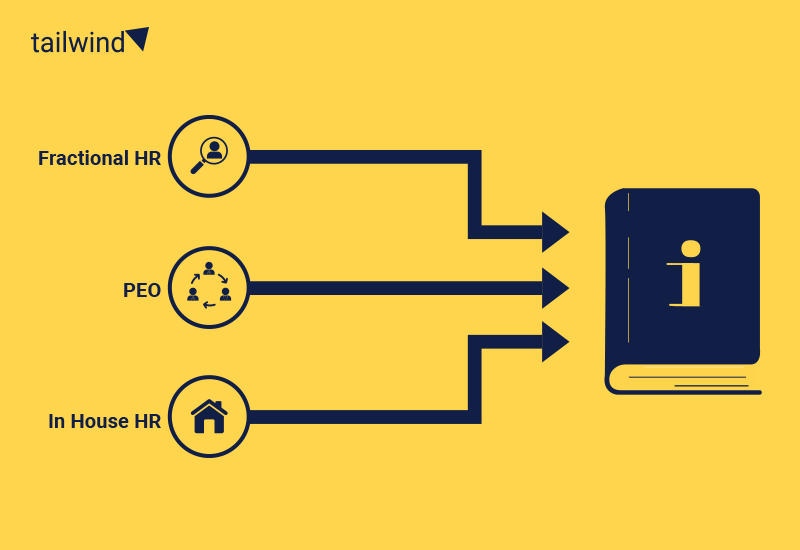
When comparing fractional HR vs PEO models, each solves the same problem (you need HR expertise) but in fundamentally different ways.
Should you hire an in-house HR person? Partner with a Professional Employer Organization (PEO)? Engage fractional HR services? Each model solves the same problem (you need HR expertise) but in fundamentally different ways.
The wrong choice costs you money, flexibility, and control. The right choice accelerates growth, reduces risk, and scales with your business.
This guide breaks down all three models so you can make an informed decision based on your stage, budget, and priorities.
TL;DR: Quick Summary
Three HR models:
- In-House: Full-time HR staff. $80k-$300k/year. Complete control, 3-6 month ramp.
- PEO: Co-employment for payroll/benefits/compliance. $90k-$300k/year. Bundled services, limited control.
- Fractional: Part-time senior HR experts. $50k-$150k/year. Strategic expertise, flexible, immediate.
Best for:
- In-House: 100+ employees, need total control
- PEO: 20-200 employees, want hands-off admin
- Fractional: 50-300 employees, need flexibility and expertise
The Three Models at a Glance
Understanding the fractional HR vs PEO distinction (along with in-house options) is critical for making the right choice. Before we dive deep, here's the high-level overview:
In-House HR: You hire HR staff as W-2 employees. They work exclusively for you, using your systems, following your processes.
PEO (Professional Employer Organization): You co-employ your staff with a PEO firm. They handle payroll, benefits, compliance, and HR administration through their platform.
Fractional HR: You engage external HR professionals who integrate into your operations part-time, working in your systems as an extension of your team.
Now let’s break down how they actually work and when each makes sense.
In-House HR: Building Your Own Team
How It Works
You hire HR staff (coordinator, generalist, manager, director, CHRO) as full-time employees. They sit in your office (or work remotely), report to your leadership, and handle all HR functions internally.
Typical structure: - Under 50 employees: 1 HR generalist or coordinator - 50-150 employees: 1-2 HR generalists, possibly an HR manager - 150-300 employees: HR manager + specialists (recruiting, benefits, compliance) - 300+ employees: HR director or CHRO leading a team.
What You Get
Complete Control
You design every process, policy, and system. Your HR team answers to you, not to external stakeholders.
Cultural Integration
Your HR people are employees who live your culture, understand your context, and develop institutional knowledge over time.
Customization
Every policy, benefit, and program can be tailored specifically to your company. No templates, no standardization.
Direct Access
Need something? Walk down the hall or send a Slack. Your HR team is available immediately, not through an account manager.
What It Costs
Let’s be honest about the numbers.
HR Generalist (Entry-Mid Level): -
- Salary: $50k-$70k
- Benefits (30%): $15k-$21k
- Total: $65k-$91k annually
HR Manager:
- Salary: $75k-$95k
- Benefits (30%): $22.5k-$28.5k
- Total: $97.5k-$123.5k annually
HR Director:
- Salary: $110k-$150k
- Benefits (30%): $33k-$45k
- Total: $143k-$195k annually
CHRO:
- Salary: $150k-$220k
- Benefits + Equity (35%): $52.5k-$77k
- Total: $202.5k-$297k annually
Plus:
- Recruiting fees (20-25% of salary): $10k-$55k
- Onboarding and ramp time: 3-6 months
- Tools and software: $5k-$15k annually
- Training and development: $3k-$8k annually
When budgeting for in-house HR staff, review DOL wage and hour compliance requirements to ensure proper classification and compensation.
First-year cost for one mid-level HR generalist: $80k-$110k all-in.
When In-House HR Makes Sense
You have 100+ employees
At this scale, you have enough HR volume to justify a full-time person.
You have complex, unique HR needs
Highly specialized industries, unique cultures, or proprietary processes that require deep institutional knowledge.
You can afford the overhead
Budget supports $100k+ for a single hire, plus benefits, tools, and management time.
You value complete control
You want every HR decision made internally, with no external dependencies.
You’re building long-term infrastructure
You’re committed to developing an HR function over multiple years, not solving immediate needs.
When In-House HR Doesn’t Make Sense
You have fewer than 75 employees
Insufficient volume to keep a full-time person busy. They’ll end up doing busy work, or you’ll underutilize them.
Your needs fluctuate dramatically
Some months, you need heavy recruiting support. Other months, nothing. Fixed headcount doesn’t match variable demand.
You can’t afford mistakes
Entry-level HR hires make mistakes. If you’re in a high-compliance industry (GovCon, healthcare, finance), those mistakes are expensive.
You need immediate expertise
Hiring, onboarding, and training someone takes 6+ months. If you need help now, this doesn’t solve your problem.
PEO: Co-Employment Model
How It Works
A PEO becomes the employer of record for your staff. Your employees technically work for both you and the PEO (co-employment). The PEO handles payroll, benefits, workers’ comp, and compliance through their platform.
Understanding IRS worker classification rules is important when entering co-employment arrangements, as tax and liability implications differ from traditional employment.
You still manage day-to-day operations, but HR administration runs through the PEO’s infrastructure.
Major players: Insperity, TriNet, Justworks, Paychex, ADP TotalSource
What You Get
Bundled Services
Payroll, benefits, workers’ comp, compliance, and basic HR support in one package.
Enterprise-Grade Benefits
Access to better health insurance rates and benefits packages by pooling with other companies.
Compliance Support
The PEO handles tax filings, labor law updates, and regulatory requirements.
Reduced Liability
Since the PEO is co-employer, they share liability for employment-related issues.
Scalability
Easy to add or remove employees without changing infrastructure.
What It Costs
PEOs charge in two ways:
Percentage of Payroll: 2-12% of gross payroll
For a company with $2M annual payroll: $40k-$240k annually
Per-Employee-Per-Month (PEPM): $150-$300 per employee
For 50 employees: $90k-$180k annually
Plus:
- Setup fees: $1k-$5k
- Workers’ comp (varies by industry)
- Locked into their benefits carriers
- Annual contracts with penalties for early termination
Total cost: Often 20-30% more than running payroll yourself, but includes bundled services.
When a PEO Makes Sense
You have 20-200 employees
The sweet spot for PEO economics. Large enough for complexity, small enough that you can’t negotiate good benefits on your own.
You want to offload payroll and compliance
If administrative burden is your main pain point, PEOs handle it efficiently.
Benefits are a priority
Access to better health insurance and 401(k) plans than you could get independently.
You’re growing fast and need infrastructure
PEOs provide instant HR infrastructure without building it yourself.
You don’t need deep customization
Their standardized processes work fine for your business.
When a PEO Doesn’t Make Sense
You value control
PEOs require you to use their systems, processes, and benefits carriers. You lose flexibility.
You’re in a niche industry
If you have unique needs (GovCon compliance, specialized compensation, complex equity), PEOs’ standardized approach won’t fit.
You want to build company culture
When employees technically work for the PEO, it can create psychological distance from your company.
You’re planning to exit
Buyers often don’t want PEO relationships. You’ll need to unwind it before acquisition, which is disruptive and expensive.
You already have good benefits
If you’ve negotiated solid benefits independently, the PEO’s pooled rates may not improve your situation.
Fractional HR: The Extension Model
How It Works
External HR professionals integrate directly into your organization, working part-time in your systems, attending your meetings, and operating as embedded members of your team.
Unlike PEOs (which replace your HR infrastructure) or in-house (which you build from scratch), fractional HR extends your existing operations.
Typical engagements:
- Fractional CHRO/HR Director: 10-20 hours/week for strategy and leadership
- Fractional HR Specialist: 20-30 hours/week for execution (recruiting, compliance, operations)
- Embedded HR Team: Mix of leadership + specialists working as your full HR function
What You Get
Strategic + Tactical
Access to both senior leadership (CHRO-level) and execution support (coordinator, specialist) without full-time costs.
System Integration
They work in YOUR tools (BambooHR, ADP, Greenhouse, Slack). No new platforms to learn.
Flexibility
Scale up to 40 hours/week during busy periods. Scale down to 5 hours during slow months. Pay for what you use.
Immediate Expertise
20+ years of HR experience from day one. No ramp time, no junior mistakes.
Cultural Fit
They embed into your culture, attend meetings, and collaborate like internal team members.
U.S. Compliance Expertise
Deep knowledge of federal and state labor laws, EEOC, ADA, FMLA, DCAA, and industry-specific regulations.
What It Costs
Fractional CHRO (10-15 hrs/week):
$5k-$10k per month = $60k-$120k annually
Fractional HR Manager (20 hrs/week):
$4k-$7k per month = $48k-$84k annually
Embedded HR Specialist (30 hrs/week):
$3k-$5k per month = $36k-$60k annually
Blended Model (Leadership + Execution):
Fractional CHRO + HR Coordinator = $8k-$12k/month = $96k-$144k annually
Compared to: - Full-time CHRO: $200k-$300k - Full-time Manager + Coordinator: $140k-$180k - PEO for 100 employees: $180k-$300k annually
Fractional delivers 40-60% cost savings while maintaining high quality.
When Fractional HR Makes Sense
You have 50-300 employees
Enough complexity to need expertise, but not enough volume for full-time staff.
You need flexibility
Your HR needs fluctuate quarter to quarter. Some months are recruiting-heavy. Others focus on compliance.
You value control + customization
You want to design your own processes but need expert guidance and execution.
You want to avoid PEO lock-in
You prefer to maintain your current benefits, payroll provider, and systems.
You’re preparing to hire full-time
Fractional HR can build infrastructure, then transition knowledge to a future full-time hire.
You’re in a high-compliance industry
GovCon, healthcare, finance, or other regulated sectors where mistakes are expensive.
Budget is constrained
You know you need senior HR expertise but can’t justify $200k+ for a full-time executive.
When Fractional HR Doesn’t Make Sense
You have 500+ employees
At this scale, you likely need dedicated full-time HR leadership and team.
You want completely hands-off HR
If you want to never think about HR again, a PEO’s fully managed service might fit better.
You need 24/7 coverage
Fractional models work specific hours. If you need around-the-clock support, in-house may be better.
You’re uncomfortable with external partners
Some companies simply prefer everyone to be a W-2 employee. That’s valid.
Fractional HR vs PEO vs In-House: Side-by-Side Comparison
| Factor | In-House | PEO | Fractional HR |
| Best for company size | 100-500+ | 20-200 | 50-300 |
| Annual cost (estimate) | $80k-$300k+ | $90k-$300k | $50k-$150k |
| Control | Complete | Limited | High |
| Customization | Total | Standardized | High |
| Flexibility | Low (fixed cost) | Medium | High (scale up/down) |
| Expertise level | Varies | Mid-level | Senior (20+ years) |
| Ramp time | 3-6 months | 1-3 months | Immediate |
| System integration | Your systems | Their platform | Your systems |
| Cultural fit | High | Low-Medium | High |
| Compliance expertise | Depends on hire | Included | Deep expertise |
| Ideal for | Large, stable orgs | Fast growth, admin-heavy | Strategic + flexible needs |
The decision between fractional HR vs PEO ultimately comes down to your priorities: control, cost, or convenience.
How to Choose: Decision Framework
Here’s a simple framework to guide your decision:
Step 1: Assess Your Employee Count
Under 50 employees:
Fractional HR or basic PEO. You don’t have enough volume for full-time staff.
50-150 employees:
Fractional HR is ideal. PEO works if you want fully managed. In-house possible if budget allows.
150-300 employees:
Fractional HR or in-house HR manager. PEO becomes expensive at this scale.
300+ employees:
In-house HR team led by director or CHRO. Consider fractional for specialized functions.
Step 2: Define Your Priority
When evaluating fractional HR vs PEO models, your priorities determine the best fit:
Priority = Control & Customization → In-house or Fractional
Priority = Hands-off convenience → PEO
Priority = Cost efficiency → Fractional
Priority = Benefits access → PEO
Priority = Strategic partnership → Fractional or In-house
Step 3: Evaluate Complexity
Low complexity (basic payroll, benefits, compliance) → PEO works fine
Medium complexity (some compliance, recruiting, performance management) → Fractional fits best
High complexity (GovCon, multi-state, unique equity, complex org design) → In-house or specialized Fractional
Step 4: Test Your Assumptions
Before committing to full-time hires or PEO contracts, test with fractional:
The fractional HR vs PEO debate often resolves itself during a trial period. Engage fractional HR for 3-6 months. If you consistently need 40+ hours/week and the ROI is clear, convert to full-time. If needs fluctuate or 15-20 hours suffices, stay fractional.
This de-risks your fractional HR vs PEO decision and gives you real data instead of guesses.
The Hybrid Approach: Mix and Match
Here's a secret: the fractional HR vs PEO decision doesn't have to be binary.
Many companies use hybrid models:
PEO for payroll + Fractional for strategy
Let the PEO handle administrative burden. Bring in fractional leadership for culture, performance, and talent strategy.
In-house generalist + Fractional specialist
Hire a full-time coordinator for daily operations. Engage fractional experts for recruiting, compliance, or compensation projects.
Fractional now, in-house later
Start with fractional to build infrastructure. Once systems are in place, transition to full-time hires.
The key is matching each function to the right resource model.
Common Myths Debunked
Several misconceptions cloud the fractional HR vs PEO comparison. Let's clear them up:
Myth: “Fractional HR is just outsourcing with a different name.”
Reality: Outsourcing firms work at arm’s length with their own systems. Fractional HR integrates directly into yours.
Myth: “PEOs save money.”
Reality: PEOs often cost 20-30% more than self-managing, but they save time and reduce complexity. It’s a trade-off, not pure savings.
Myth: “In-house HR is always better because they understand your culture.”
Reality: Understanding culture takes time. A fractional CHRO with 20 years of experience can learn your culture faster than a junior in-house hire.
Myth: “You need to pick one and stick with it.”
Reality: Your HR model should evolve as you grow. Start fractional, add in-house, phase out PEO. Flexibility matters.
The Bottom Line
There's no universal "best" HR model. The fractional HR vs PEO choice depends on your stage, budget, priorities, and complexity.
Choose In-House if: You’re 100+ employees, have the budget, value total control, and are building long-term.
Choose PEO if: You’re 20-200 employees, want hands-off administration, need better benefits, and don’t require deep customization.
Choose Fractional if: You’re 50-300 employees, need strategic expertise with flexibility, want to maintain control, and value cost efficiency.
When weighing fractional HR vs PEO options, most growing companies find fractional HR to be the sweet spot: strategic value, flexible scaling, and cost savings that make the CFO happy.
Ready to Explore Fractional HR?
If this fractional HR vs PEO comparison has you leaning toward the fractional model, we're here to help.
At Tailwind, we’ve built our model around integration, not isolation. We work in your systems, attend your meetings, and deliver results that look and feel like they came from an internal team.
Whether you need a fractional CHRO for strategic guidance, embedded specialists for execution, or a full HR extension team, we’ll design an engagement that fits your stage, budget, and goals.
Book a free discovery call to discuss your specific situation, or download our HR Capability Statement to see how fractional HR works in practice.
Because the best HR solution isn’t the most expensive one. It’s the one that scales with your business.