
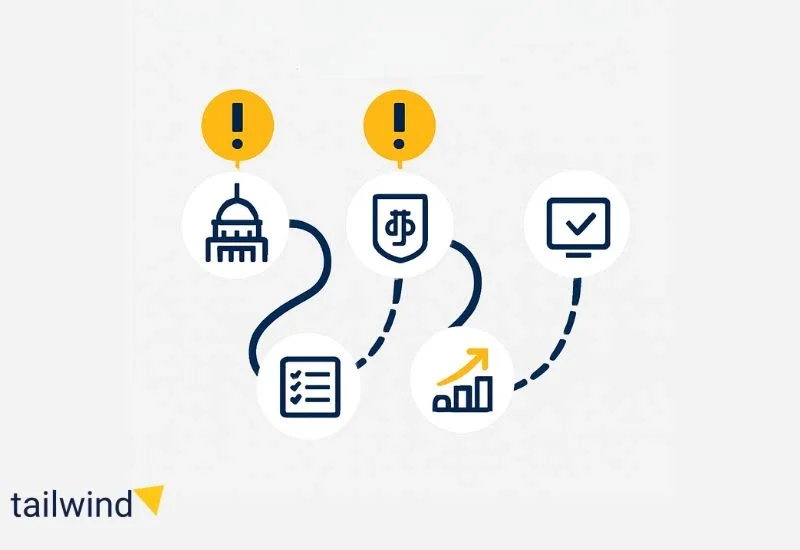
Federal HR compliance applies to virtually every U.S. employer, but the specific requirements depend on your company size, industry, and employee locations.
This guide breaks down federal HR compliance in plain English, explains when each law applies, and provides practical guidance on building compliant systems without unnecessary complexity.
TL;DR: Quick Summary
Core federal HR laws: FLSA (wage and hour), Title VII (discrimination), ADA (disability), FMLA (leave), OSHA (safety), I-9 (work authorization). Different laws have different employee count thresholds.
Key principle: Compliance requirements scale with company size. At 15 employees, you’re subject to federal anti-discrimination laws. At 50 employees, FMLA applies.
Most common violations: Wage and hour mistakes, failure to accommodate disabilities, retaliation against complaints, missing documentation.
Best defense: Know which laws apply to you, build compliant systems from the start, document decisions, train managers.
Understanding the Threshold System
Understanding federal HR compliance starts with employee count thresholds that determine which laws apply to your company.
1-14 Employees:
- FLSA (wage and hour)
- EPA (equal pay)
- IRCA (work authorization)
- OSHA (workplace safety)
- COBRA (if offering health insurance)
15-19 Employees:
All of the above, plus:
- Title VII (discrimination based on race, color, religion, sex, national origin)
- ADA (disability discrimination and accommodation)
- GINA (genetic information discrimination)
- PDA (pregnancy discrimination)
20-49 Employees:
All of the above, plus:
- ADEA (age discrimination for employees 40+)
- COBRA (health insurance continuation)
- OWBPA (older worker protections in severance)
50+ Employees:
All of the above, plus:
- FMLA (family and medical leave)
- ACA employer mandate (health insurance requirements)
- EEO-1 reporting (if 100+ employees)
Important Note: These are federal thresholds. State laws often have lower thresholds or additional requirements.
Building federal HR compliance systems means knowing which laws apply at each growth stage and implementing appropriate policies and procedures.
The Core Federal Laws
FLSA: Fair Labor Standards Act
Who it applies to: All employers engaged in interstate commerce (essentially everyone).
The Fair Labor Standards Act is the foundation of federal HR compliance for all employers, regardless of size.
What it requires:
- Pay at least federal minimum wage ($7.25/hour, though many states have higher minimums)
- Pay overtime (1.5x regular rate) for hours over 40 in a workweek for non-exempt employees
- Properly classify employees as exempt or non-exempt
- Keep accurate time and pay records
- Follow child labor restrictions
Common violations:
- Misclassifying employees as exempt
- Not paying for all hours worked (off-the-clock work)
- Calculating overtime incorrectly
- Improper deductions from exempt employees’ pay
Practical compliance:
Track all hours worked for non-exempt employees. Document the basis for exempt classifications.
Ensure overtime calculations include all required components (bonuses, shift differentials). Review classifications annually.
Key exempt employee tests:
To be classified as exempt from overtime, employees generally must meet three tests:
Salary basis: Paid predetermined amount each pay period, not subject to reduction based on quality or quantity of work.
Salary level: Minimum of $684/week ($35,568 annually) as of current regulations.
Duties test: Primary duties must be executive, administrative, or professional as defined by DOL regulations.
All three must be met. If any fail, employee is non-exempt and entitled to overtime.
Title VII: Civil Rights Act
Who it applies to: Employers with 15+ employees.
Title VII of the Civil Rights Act is a critical component of federal HR compliance once you reach 15 employees.
What it requires:
Protection from discrimination based on:
- Race
- Color
- Religion
- Sex (including pregnancy, sexual orientation, gender identity)
- National origin
Applies to hiring, firing, promotion, compensation, benefits, and all other employment terms.
Common violations:
- Discriminatory hiring practices
- Pay disparities without legitimate business justification
- Failure to accommodate religious practices
- Sexual harassment or hostile work environment
- Retaliation against employees who complain
Practical compliance:
Use objective criteria for hiring and promotion decisions. Document reasons for pay differences. Implement anti-harassment policies and training. Investigate complaints promptly and thoroughly. Never retaliate against complainants.
What constitutes harassment:
Unwelcome conduct based on protected characteristics that is severe or pervasive enough to create hostile work environment. Single incident can be enough if sufficiently severe.
Employer liability:
Employers are liable for supervisor harassment. For co-worker harassment, employer is liable if knew or should have known and didn’t take corrective action.
ADA: Americans with Disabilities Act
Who it applies to: Employers with 15+ employees.
The Americans with Disabilities Act requires reasonable accommodations for qualified individuals with disabilities.
What it requires:
- No discrimination based on disability
- Reasonable accommodation for qualified individuals with disabilities
- Interactive process to identify accommodations
- Confidentiality of medical information
What is a disability:
A physical or mental impairment that substantially limits one or more major life activities. This is broadly interpreted and includes many conditions.
What is reasonable accommodation:
Modifications that enable a qualified individual to perform essential job functions, unless it creates undue hardship (significant difficulty or expense).
Examples of reasonable accommodations:
- Modified work schedule
- Reassignment to vacant position
- Ergonomic equipment
- Modified policies (such as allowing service animal)
- Leave as accommodation
- Remote work arrangements
Common violations:
- Refusing to engage in interactive process
- Denying reasonable accommodations
- Asking disability-related questions before job offer
- Failing to keep medical information confidential
- Terminating instead of accommodating
Practical compliance:
When employee requests accommodation or mentions health issue, initiate interactive process immediately.
Request medical documentation if needed. Explore multiple accommodation options. Document process and decision. Grant reasonable accommodation unless undue hardship. Keep medical information in separate confidential file.
FMLA: Family and Medical Leave Act
Who it applies to: Employers with 50+ employees.
At 50+ employees, the Family and Medical Leave Act becomes a key federal HR compliance requirement.
What it requires:
Up to 12 weeks of unpaid, job-protected leave per year for:
- Birth and care of newborn
- Placement of child for adoption or foster care
- Care for spouse, child, or parent with serious health condition
- Employee’s own serious health condition
- Qualifying exigencies related to family member’s military deployment
Up to 26 weeks for military caregiver leave.
Employee eligibility:
Must have worked for employer for 12 months, worked at least 1,250 hours in previous 12 months, and work at location with 50+ employees within 75 miles.
Common violations:
- Denying leave to eligible employees
- Retaliating against employees who take leave
- Failing to maintain health benefits during leave
- Not restoring employee to same or equivalent position
- Interfering with FMLA rights
Practical compliance:
Provide required notices (at hire, when leave requested, designation notice). Track leave carefully. Maintain health benefits during leave. Restore employee to same or equivalent position. Never retaliate. Document all communications and decisions.
FMLA and other leave:
FMLA runs concurrently with other leave types (sick leave, disability, workers’ comp). Employer can require use of accrued paid leave during FMLA.
COBRA: Consolidated Omnibus Budget Reconciliation Act
Who it applies to: Employers with 20+ employees offering group health insurance.
What it requires:
Continuation of group health coverage for 18-36 months (depending on qualifying event) when coverage would otherwise end due to:
- Termination or reduction in hours (18 months)
- Death of employee (36 months for dependents)
- Divorce or legal separation (36 months)
- Child ceasing to be dependent (36 months)
- Medicare entitlement (36 months for dependents)
Common violations:
- Not providing required notices
- Missing election deadlines
- Charging incorrect premiums
- Not offering all benefits available under plan
- Terminating coverage during election period
Practical compliance:
Provide general COBRA notice at time of hire. Provide specific COBRA notice within 14 days of qualifying event. Allow 60 days for election. Ensure premiums calculated correctly (102% of plan cost). Many employers outsource COBRA administration to avoid complexity.
ACA: Affordable Care Act (Employer Mandate)
Who it applies to: Employers with 50+ full-time equivalent employees.
What it requires:
Offer affordable, minimum value health coverage to full-time employees (30+ hours/week) or pay penalties.
Coverage must be:
- Affordable: Employee contribution for self-only coverage cannot exceed 9.12% of household income (2023)
- Minimum value: Cover at least 60% of covered health expenses
Reporting requirements:
Forms 1095-C to employees and 1094-C to IRS annually reporting coverage offered and employee status.
Common violations:
- Not offering coverage to all full-time employees
- Offering coverage that’s not affordable
- Missing reporting deadlines
- Incorrect classification of full-time vs. part-time employees
Practical compliance:
Track hours carefully to identify full-time employees. Use safe harbors for affordability. Complete required reporting. Consult benefits attorney or consultant for complex situations.
I-9 and Work Authorization (IRCA)
Who it applies to: All employers.
What it requires:
Complete Form I-9 for every employee hired after November 6, 1986, verifying identity and work authorization.
Timeline:
Form must be completed within 3 business days of hire. Section 1 (employee completes) on or before first day of work. Section 2 (employer completes) within 3 business days of start date.
Common violations:
- Not completing I-9 at all
- Missing deadlines for completion
- Accepting wrong documents
- Not re-verifying when work authorization expires
- Discriminating based on documentation presented
- Storing I-9s incorrectly
Practical compliance:
Complete I-9 for everyone within required timeline. Accept any documents from List A or combination of List B and List C. Re-verify when work authorization expires. Store I-9s separately from personnel files. Audit I-9s annually for compliance. Be prepared for ICE audit.
OSHA: Occupational Safety and Health Act
Who it applies to: All private sector employers.
What it requires:
- Provide workplace free from recognized hazards
- Comply with OSHA standards for your industry
- Keep records of work-related injuries and illnesses (if 11+ employees)
- Report serious injuries, fatalities
- Provide required training
Common violations:
- Inadequate safety training
- Missing required postings
- Failure to report incidents
- Inadequate recordkeeping
- Industry-specific violations
Practical compliance:
Conduct safety training appropriate to your industry. Post OSHA notices. Report fatalities within 8 hours, hospitalizations within 24 hours. Keep OSHA 300 log if 11+ employees. Respond promptly to OSHA inquiries. Address identified hazards.
Building Federal HR Compliance Systems
Creating effective federal HR compliance systems requires documentation, policies, and procedures that scale with your growth.
Essential Policies (Required for Federal Compliance)
Anti-Discrimination and Harassment Policy
Required once you reach 15 employees. Must cover all protected classes, establish complaint procedure, commit to investigation, prohibit retaliation.
At-Will Employment Statement
Clarifies employment relationship can end at any time for any lawful reason. Include in handbook and offer letters.
FMLA Policy (if 50+ employees)
Explains eligibility, reasons for leave, request process, benefits continuation, job restoration.
Reasonable Accommodation Process
Explains how to request accommodations for disabilities or religious practices, interactive process, confidentiality.
Workplace Safety Policy
Addresses hazards specific to your workplace, reporting procedures, training requirements.
Required Documentation
For All Employers:
- I-9 forms (separate file)
- Time records for non-exempt employees (3 years minimum)
- Payroll records (3 years minimum)
- Personnel files (applications, offer letters, performance documentation)
- Safety training records
For Employers with 15+ Employees:
- Documentation of hiring decisions
- Accommodation requests and responses
- Investigation records for complaints
- Termination documentation
For Employers with 50+ Employees:
- FMLA requests and approvals
- FMLA leave tracking
- ACA reporting documentation
Manager Training Requirements
Managers are your front line for federal HR compliance. They must understand:
All Managers:
- Wage and hour basics (tracking time, approving overtime)
- Non-discrimination and anti-harassment
- When to escalate to HR
- Documentation standards
Managers at 15+ Employees:
- Prohibited discrimination and harassment
- How to respond to accommodation requests
- Complaint handling procedures
- Retaliation risks
Managers at 50+ Employees:
- FMLA basics and process
- Leave request handling
- Benefits continuation during leave
Compliance Monitoring
Quarterly:
- Review time records for completeness
- Check I-9 completion for new hires
- Review any complaints or accommodation requests
- Update postings if required
Annually:
- Review employee classifications (exempt vs. non-exempt)
- Conduct I-9 audit
- Review and update policies
- Manager compliance training
- Compensation analysis for pay equity
Common Federal HR Compliance Mistakes
The most common federal HR compliance violations are preventable with proper systems and awareness.
Mistake: Misclassifying Employees as Exempt
The mistake: Treating employees as exempt from overtime when they don’t meet all three tests (salary basis, salary level, duties).
Why it happens: Job titles are misleading. “Manager” title doesn’t make someone exempt if they don’t manage people or make independent decisions.
The cost: Back wages for all overtime not paid, potentially for 2-3 years. Liquidated damages (doubling the amount). Penalties. Legal fees.
How to avoid:
Review DOL fact sheets for exempt classifications. Document basis for each exempt classification. Conduct annual audit of classifications. When in doubt, classify as non-exempt.
Mistake: Not Engaging in ADA Interactive Process
The mistake: Employee mentions health issue or requests modification. Employer ignores, denies without discussion, or terminates instead of exploring accommodation.
Why it happens: Managers don’t recognize accommodation requests. Fear of setting precedent. Assumption that accommodation would be expensive.
The cost: ADA lawsuits are expensive. Damages, legal fees, reputational harm.
How to avoid:
Train managers to recognize potential accommodation situations. Initiate interactive process whenever employee mentions health issue. Explore multiple accommodation options. Document process. Grant reasonable accommodation unless undue hardship.
Mistake: Retaliating Against Complaints
The mistake: Employee complains about discrimination or harassment. Employer takes negative action (termination, demotion, schedule change, poor review).
Why it happens: Managers get defensive. Want to “deal with” the complainer. Don’t understand retaliation is separate violation.
The cost: Retaliation claims are easier to prove than underlying discrimination claims and carry significant penalties.
How to avoid:
Never take negative action against someone who complained. Separate complaint investigation from performance issues. Train managers on retaliation risks. Document legitimate business reasons for any action. Monitor for subtle retaliation (ostracism, micromanagement).
Mistake: Not Documenting Decisions
The mistake: Making employment decisions (hiring, promotion, compensation, termination) without documentation of reasons.
Why it happens: Busy managers don’t take time to document. Assume decisions are obviously justified.
The cost: “We fired him for performance” doesn’t help if you have no documentation showing performance problems. Lack of documentation makes discrimination claims harder to defend.
How to avoid:
Document performance issues as they occur. Document reasons for pay differences. Document hiring criteria and how candidates compared. Document termination decisions with specific examples. Contemporary documentation (at the time of decision) is most credible.
When to Get Help
Some federal HR compliance issues require expert guidance rather than DIY approaches.
Legal Counsel:
- Discrimination complaints
- EEOC charges
- Retaliation claims
- Complex accommodation situations
- Layoffs or restructuring
- Investigation of serious misconduct
HR Consultant:
- Policy development
- Classification audits
- Compensation analysis
- FMLA administration
- Manager training
- Compliance system implementation
Benefits Consultant:
- COBRA administration
- ACA compliance
- ERISA compliance
- Benefits plan design
The cost of expert guidance is almost always less than the cost of violations.
The Bottom Line
Federal HR compliance has complexity, but the fundamentals are straightforward:
- Know which laws apply based on your size and industry
- Pay people correctly and on time
- Treat people fairly and consistently
- Document decisions
- Respond appropriately to requests and complaints
Most compliance issues arise from ignorance, not malice. Companies that invest in understanding requirements and building basic systems avoid most problems.
Federal HR compliance doesn’t require sophisticated systems. It requires awareness of which laws apply, basic policies covering required topics, consistent practices, and documentation of decisions.
The laws exist to prevent workplace harm. Following them isn’t just about avoiding penalties. It’s about creating fair, safe workplaces where people can succeed.
Mastering federal HR compliance doesn’t require legal expertise - it requires commitment to understanding obligations and building appropriate systems that scale with growth.
Need Help Building Federal HR Compliance Systems?
At Tailwind, we help growing companies understand their federal HR compliance obligations and build practical systems that meet requirements without unnecessary complexity.
We conduct compliance assessments, develop policies and procedures, train managers on compliance responsibilities, and build federal HR compliance systems that scale with growth.
Book a free compliance assessment to identify your current compliance gaps and get practical recommendations for remediation.
Because compliance doesn’t have to be complicated to be effective